From four sources, the model proposes who owns each inherited machine and which vendor update closes its findings.
One fix per patch covers the machines one approver answers for. The list of unpatched machines and their owners never reaches an outside model provider.
It reads four sources and proposes two things.
Owner proposal
who owns the machine, and which two sources agree


Fix proposal
one vendor update, with its canary, undo and approver
Each proposal carries its reasons: the two sources that agree, or the advisory that names the update.
Example: Tess Okonjo proposed for an accounting file server, and one update for six file servers. Both people are made up.
It reads these four, and nothing in anyone's mail, files, chats or screens.
Example: one acquired machine through the four sources. The CMDB and the old spreadsheet are read for names and shown as hints; they never count toward an owner.
- The scanner export
- each finding, CVE, score and the scanner's solution
- The endpoint inventory
- names, agent ID, serial number, software, last seen
- Sign-in records
- who signs in, and how often, as weekly counts
- The acquired directory
- each computer's manager and group

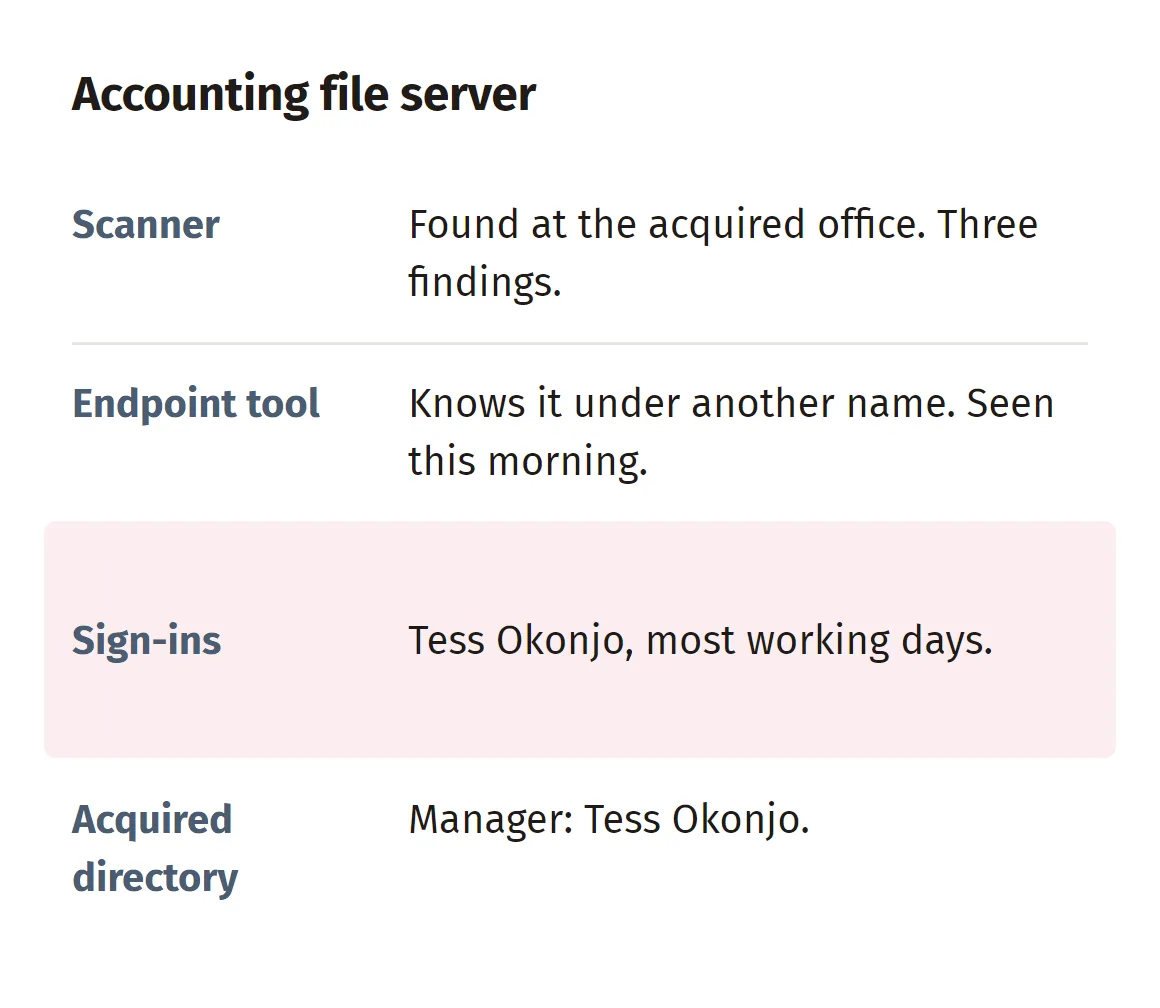
Two sources have to agree before it names anyone.
The settings behind it, for anyone who asks: two names join only when the matcher is nearly certain, and sign-ins name someone only when nobody else comes close. Settings, not accuracy figures.
An owner is proposed only when two independent sources name the same person. Otherwise the model asks the director.
A fix comes only from the vendor's published update, cited and checked, for two canary machines inside your window.
A finding closes only when your scanner's rescan stops reporting it.
It holds a machine before it guesses an owner.
Example: the old print server. No sign-ins in three months, in neither directory, known only to the scanner.
Without grounds for a proposal, it holds the machine and says why.
- Nobody named for a machine only the scanner knows: the director decides
- No script, no package of its own: code models invent package names
- No keys to your device tools: only the gate holds those

Example: a held machine, and the director's three choices: Keep it, Switch it off, Name an owner.
The owner confirms the machine, the approver on the fix says yes, the director opens the wave.
Approvals happen in the console, never in chat. Each owner's answer tunes your own copy of the owner ranker.
The model
proposes owners and fixes with its reasons, and drafts each change
The people
confirm ownership, approve each change, decide every held machine